The Anachronism series began by examining
how Korean art has continued to understand and organize itself under changing
conditions through languages, institutions, and models of success inherited
from the past.
It considered the recurring tendency to
reproduce earlier formulas under fundamentally different conditions and
explored the future conditions required to accumulate documentation, knowledge,
and trust rather than prioritizing one-off events and short-term visibility.
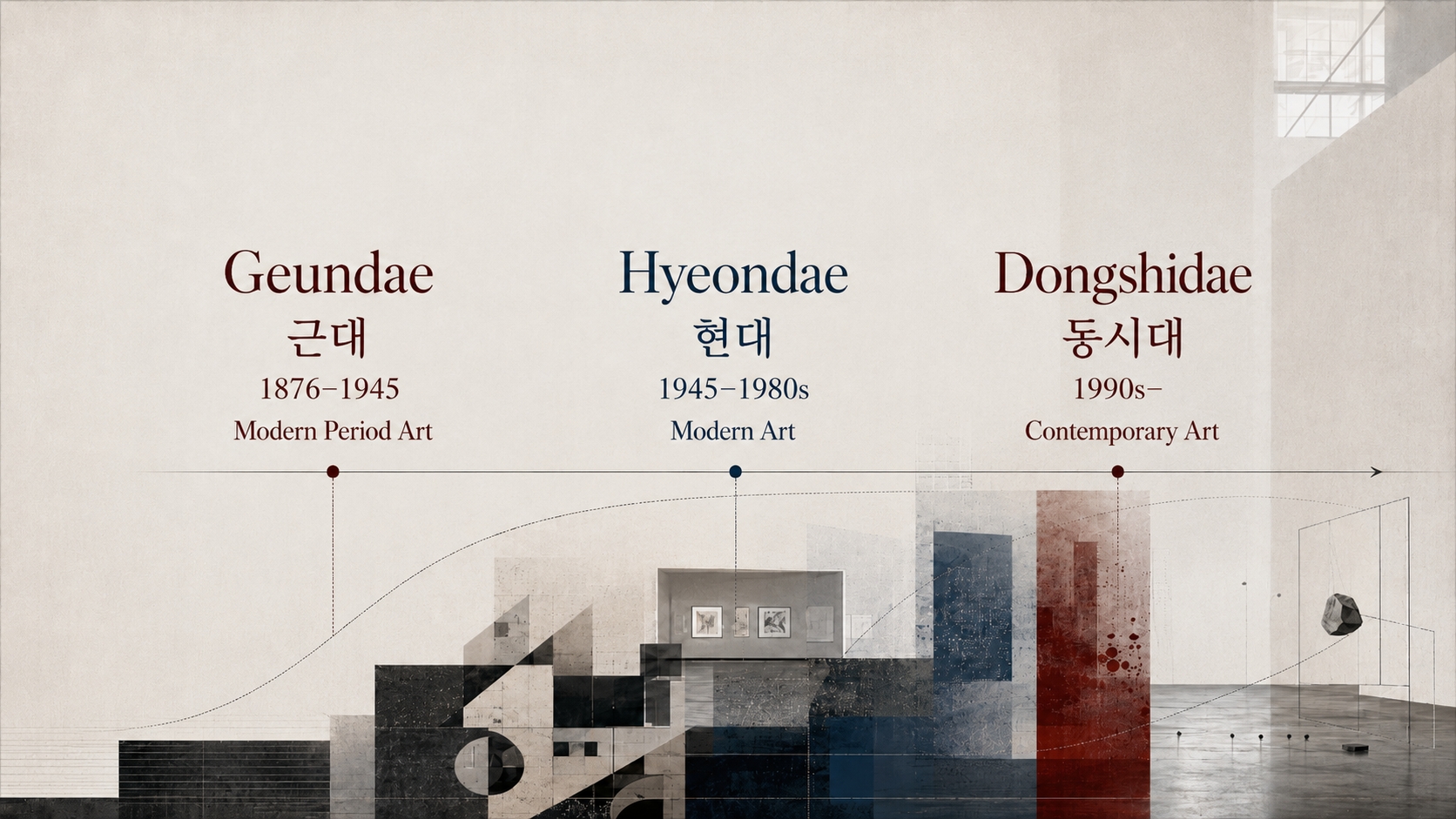
It then examined the confusion surrounding
the Korean art-historical categories of geundae, hyeondae, and dongshidae—terms
commonly translated as modern, modern or contemporary, and contemporary—demonstrating
that anachronism exists not only in policy and institutional systems but also
in the ways art history itself is understood.
The final question is now clear. What
should Korean art carry forward from the past, and what must it change? Who
should lead that transformation, and how can it be translated into an actual
working structure?
Answering this question does not require a
wholesale rejection of the past. Artistic autonomy, critical judgment, the
research and preservation functions of public institutions, the sustained
development of artists by galleries, international exchange, and cultural
openness have all contributed to the development of Korean art. These remain
essential values that should be carried forward.
The methods through which these values have
been realized, however, cannot simply be repeated unchanged.
What Korean art must change is not the
values inherited from the past, but the structures that continue to reproduce
outdated practices under fundamentally transformed conditions.
Values to Preserve, Systems to
Change
Not every institution or form is
anachronistic simply because it was created in the past. The continued
existence of traditional painting and sculpture, or of long-established museums
and galleries, is not in itself a problem. Conversely, the use of artificial
intelligence, virtual reality, immersive media, or other new technologies does
not automatically make an artwork or institution future-oriented.
An institution may use the latest
technologies while still treating artists as objects of short-term attention,
placing events and publicity ahead of artworks, and reproducing closed systems
of authority and opaque structures of circulation. Conversely, artists working
with traditional genres and media can be entirely contemporary when their work
interprets present conditions from a new perspective and expands established
ways of seeing.
Anachronism should therefore not be judged
by the age of a form or the novelty of a technology. It should be judged by
whether an institution or practice accurately understands present conditions,
whether it has reorganized its functions in response to a changing environment,
whether it expands the possibilities of creation and judgment, and whether it
leaves behind knowledge and assets that future generations can use.
Korean art must preserve artistic autonomy
and experimentation, professional judgment and criticism, the public mission
and research functions of museums, sustained commitment to artists’ long-term
development, and international openness. What it must change are operating
systems centered on one-off events and short-term results, closed structures in
which the grounds for judgment remain undisclosed, exhibitions and funding
programs that fail to accumulate documentation and knowledge, and outdated
systems of classification and evaluation that can no longer explain present
conditions.
The Density of Accumulation,
Not the Scale of Achievement
The first transformation Korean art must
undertake concerns how achievement is defined and evaluated.
The number of exhibitions, visitor
attendance, media exposure, participation in overseas events, the scale of
public funding, and sales prices have long served as representative indicators
of success. Such figures are useful for measuring the external scale and
short-term results of a project. They do not, however, adequately reveal what
an artwork, artist, institution, or art ecosystem has actually accumulated.
In the future, the question should not
simply be how many exhibitions were organized, but what research and
documentation remained after they ended. Rather than counting the number of
overseas exhibitions or international appearances, we should examine whether
those experiences led to sustained criticism, research, exhibitions,
acquisitions, or subsequent collaborations. Visitor numbers should be
considered alongside the impact an exhibition had on public understanding,
education, research, and discourse.
An artist’s long-term development within
the market cannot be assessed solely by short-term price increases or
transaction volume. Provenance, exhibition history, transparency in
transactions, consistency in price formation, and the development of long-term
collections must also be considered. High prices can be generated by temporary
attention, but trust can only be built through sustained documentation and
verification.
The art ecosystem of the future should be
evaluated not by the scale of an event, but by the density of the assets that
remain after it. An exhibition may close, but its documentation and research
should remain. A funding program may end, but the data, relationships,
judgments, and experience created through it should accumulate as the starting
point for subsequent activities.
Why Does Information on Korean
Art Fail to Accumulate?
Every year in Korea, countless exhibitions
are organized, artworks are produced, and criticism, research, press releases,
and interviews are published. Museums, galleries, biennials, art fairs,
universities, research institutions, media organizations, and digital platforms
all generate vast amounts of information within their respective fields.
Yet most of this information remains
dispersed across individual institutions and projects. When an exhibition ends,
its webpage may disappear or become difficult to access. Artists’ biographies
and information about their works are organized differently by each
institution. Korean- and English-language materials often fail to correspond,
while titles, materials, dimensions, dates of production, exhibition histories,
and collection records are documented according to inconsistent standards.
Institutions repeatedly research and
translate material that another institution has already processed. At the same
time, even when significant criticism or research has been produced, it is
often difficult to locate. Overseas museums, researchers, curators, and
collectors have no easy way to access reliable information on Korean art in a
single place.
The problem is not that the information
does not exist. The problem is that it is dispersed, disconnected, and not
maintained over time.
Information that is not shared cannot
become collective knowledge. Materials that cannot be searched, connected, or
reused may technically exist, but they cannot adequately contribute to
international art history, research, exhibitions, or the market.
A Public Platform Is Essential
Infrastructure for Korean Art
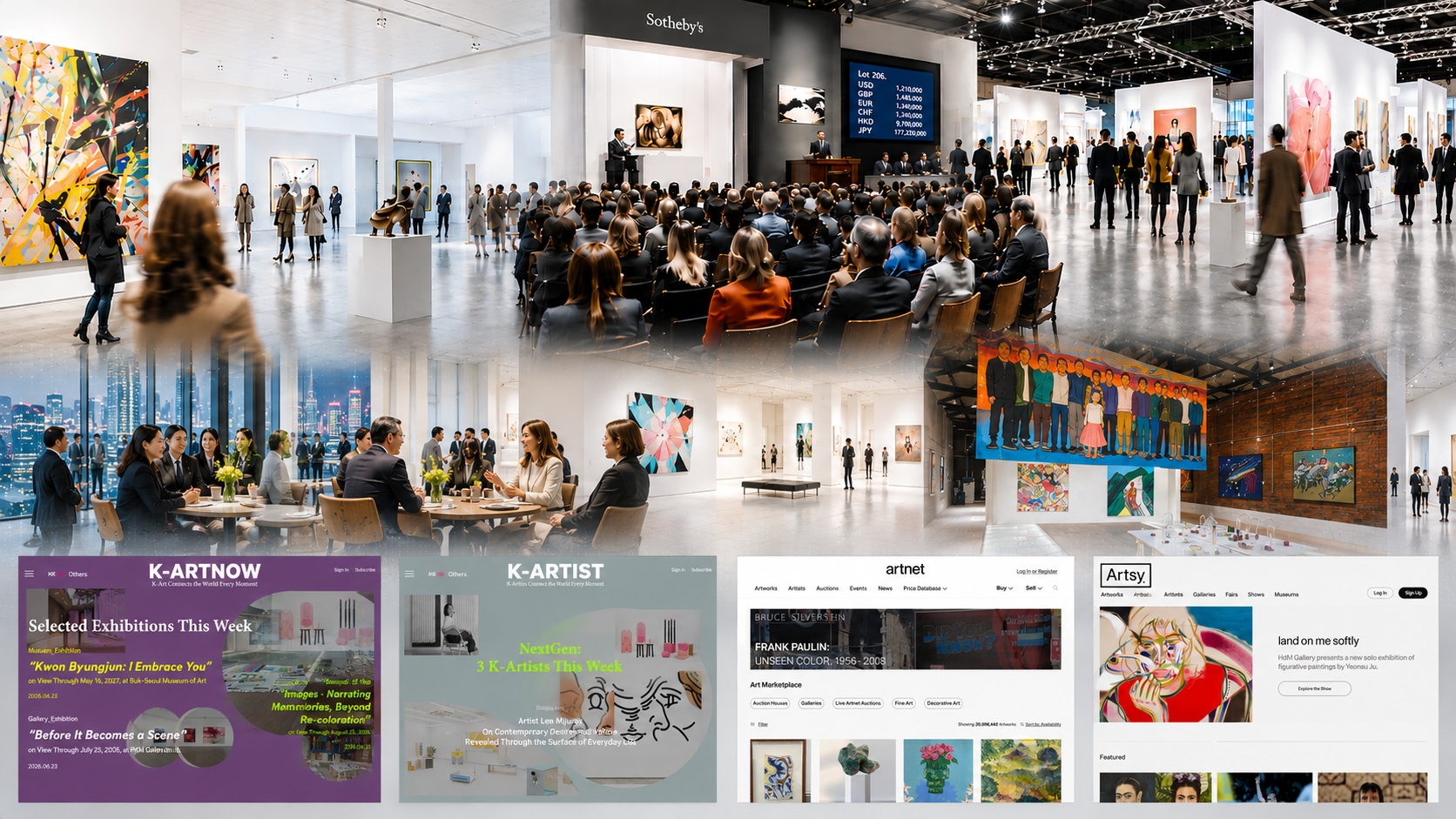
Korea now needs a nationally coordinated
public platform through which information, research, exhibition records, and
materials on artists and artworks can be collectively accumulated and used.
Such a platform must not be a simple portal
that merely aggregates exhibition schedules and institutional news. It should
function as a public knowledge infrastructure supporting the production,
research, preservation, and international circulation of Korean contemporary
art.
Information on exhibitions, artists,
artworks, criticism, research, collections, publications, open calls,
residencies, international exchanges, and the market should be interconnected.
Materials produced by museums, galleries, biennials, art fairs, independent
spaces, universities, critics, media organizations, artists, and digital
platforms should be capable of integration according to shared standards.
International users must also be able to
access and use up-to-date information on Korean contemporary art. The platform
should continuously document the countries and institutions in which Korean
artists are exhibiting, which works are being collected or researched, where
new criticism and publications are being produced, and what kinds of networks
are being formed within the international art world.
Such a platform must be fundamentally
different from a national branding website designed primarily to promote Korean
art. Promotion selectively presents successful outcomes. A knowledge
infrastructure records the processes and histories through which art is
produced, together with its criticism, documentation, achievements, and
limitations. What the international art world needs is not another set of
promotional slogans, but accurate, verifiable, and continuously updated
information.
A public platform should not merely serve
as a window through which Korean art is introduced. It should become an
infrastructure that international museums, researchers, educators, curators,
collectors, and market professionals actually use to research, exhibit, teach,
collect, and engage with Korean art.
Artist Documentation Must Meet
International Standards
At the core of any public platform must be
systematic documentation of artists and artworks.
Simply listing images and basic biographies
of Korean artists is not sufficient. Artwork titles, dates of production,
materials, dimensions, edition information, collection records, exhibition
histories, publications, criticism, relevant literature, and audiovisual
materials must be organized according to internationally recognized standards.
The English renderings of artists’ names,
artwork titles, materials, and techniques must be standardized and consistent.
Korean- and English-language materials should be interconnected, while record
creation dates, revision histories, sources, and copyright status must be
clearly managed. Artists should be able to update information on their works
and exhibitions continuously, while museums, galleries, researchers, and
collectors should be able to access and use the material within appropriate
limits.
Such documentation should not be reserved
for established or highly visible artists, or for those currently attracting
market attention. It must also record emerging and mid-career artists, artists
working in regional contexts, and artists who have not yet received sufficient
scholarly attention. International recognition is not created by repeatedly
circulating information on artists who are already known. It emerges from an
infrastructure that makes it possible to discover and research artists and works
that have not yet been adequately recognized.
The systematic organization of artist
information is not a promotional service. It is a fundamental cultural
infrastructure that verifies provenance, enables art-historical research, and
strengthens trust in exhibitions, collections, transactions, and conservation.
We Must Build a Protocol, Not
Merely a Project
The creation of a nationally coordinated
public platform will not automatically solve every problem. Building another
website and collecting information for a limited period would be likely to
reproduce existing failures.
What matters is not the external form of
the platform, but the creation of shared protocols that can be used by multiple
institutions and individuals.
Common metadata standards are needed for
documenting artists and artworks, together with consistent conventions for
recording titles, materials, dimensions, and dates of production. Systems are
also required to connect exhibition, collection, and transaction histories. The
platform must ensure data interoperability so that information held in
different formats by different institutions can be connected.
Standards must also determine how materials
should be preserved and made public after exhibitions and funding programs have
ended, how much of the reasoning behind selection and review processes at
public institutions should be disclosed, and how copyright, image use, personal
information, and transaction data should be protected.
Rather than allowing a single central
institution to own and control all information, the platform should enable
individual institutions and artists to manage their own materials while
connecting them through common standards. If one institution controls all
content, the system may become vulnerable to administrative rigidity, political
influence, and discontinuity whenever its leadership or operating body changes.
The state should provide the
infrastructure, standards, and long-term operating resources. The judgment and
interpretation of content, however, should be governed by an independent
structure in which museums, archives, universities, researchers, artists,
galleries, private platforms, and technology specialists participate together.
Serving the public interest does not mean
that the state must directly own and control everything. It means guaranteeing
a sustainable structure through which reliable information can be accessed and
used equitably.
Domestic Platforms Must Be
Connected to International Networks
Accumulating information on Korean art
within Korea is not enough. That information must be connected to the
international networks actually used by overseas museums, universities,
research institutions, curators, galleries, and collectors.
This requires more than English
translation. The underlying structure must be designed for international
search, scholarly research, exhibition planning, and artwork management.
Information on Korean artists and artworks should be capable of connection with
international museum collection databases, academic research, and exhibition
records. Information on Korean art produced abroad should, in turn, be
incorporated into the domestic platform.
We must reduce situations in which a Korean
artist exhibits overseas but no record of the exhibition remains in Korea, in
which important research is published abroad but remains unknown to the artist
or relevant Korean institutions, or in which domestic and international
information on the same artist remains disconnected.
International exchange is not a one-way
process of transmitting information from Korea to the rest of the world. It
must be a reciprocal structure through which documentation, research, critical
assessments, and professional networks formed both domestically and
internationally continue to circulate.
When this kind of real-time exchange
becomes possible, Korean art can move beyond being an object of temporary
international attention and become a field that the international art world
continuously researches, exhibits, and debates.
The Roles of the Public and
Private Sectors Must Be Distinct Yet Interconnected
The call for a nationally coordinated
public platform does not imply that private platforms and art institutions
should be replaced.
A public platform should take
responsibility for common standards, long-term preservation, public
accountability, and equitable access. Private platforms can develop specialized
curation, rapid implementation, new services and technological experiments, and
functions tailored to the needs of the market and users.
Museums and research institutions should
ensure the accuracy and scholarly interpretation of information. Galleries and
market participants should ensure the accuracy and traceability of artwork and
transaction records. Artists should document and update their practices and
careers, while critics and media organizations should produce knowledge that
interprets and evaluates artworks and exhibitions.
The role of the state is not to perform all
of these tasks directly. It is to establish an infrastructure through which the
information produced by different actors can be connected through common
standards and accumulated as a public asset.
A public platform that excludes the
expertise and technology accumulated by the private sector is likely to become
rigid. A private platform without public standards and long-term responsibility
may become dependent on market demand and short-term profitability. What is
needed is a structure that distinguishes the roles of the public and private
sectors while connecting them.
The answer to the question of who will
change the future of Korean art does not lie with a single institution or
individual. It begins with a shared infrastructure that connects the
information, judgments, experiences, and materials produced by all participants.
Korea Must Become a Producer,
Not Merely a Consumer, in the Global Art World
The international competitiveness of Korean
contemporary art cannot be judged solely by how many Korean artists exhibit
abroad or how much their market prices increase.
A more important question is whether Korea
can produce not only new artworks and artists, but also criticism and
discourse, research and exhibition models, data and digital infrastructure, and
trustworthy standards for the market.
Internationalization has often been
understood as the process of integrating Korean artists into the standards and
institutions already established by the global art world. To secure lasting
influence within the international landscape, however, Korea must move beyond a
position in which it waits to be selected by external institutions.
Artworks, exhibitions, research, and
criticism produced in Korea should generate international debate. Korean
museums and platforms should become sources of knowledge used by researchers
and curators around the world. Methods of documentation, archiving, artwork
management, and information sharing developed in Korea should be capable of
becoming models referenced by institutions in other countries.
For Korea to become a major site of
production in the global art world means more than increasing the quantity of
artworks produced or expanding the scale of the art market. It means
continuously producing and sharing new artistic languages, knowledge, criteria
of judgment, and systems of circulation.
The competitiveness of Korean contemporary
art depends less on how effectively it communicates recognizably Korean images
than on how consistently it produces new artistic values and forms of knowledge
that the world can discuss and use together.
This requires an infrastructure that goes
beyond the achievements of individual artists and institutions and enables the
Korean art world as a whole to accumulate knowledge and information
collectively. Artworks are created individually, but art history is formed
through collective documentation and judgment.
From Sharing Information to
Creating a New Reality
Moving beyond anachronism does not mean
erasing the past. It means understanding the conditions under which past
institutions and practices were created and distinguishing between the values
that remain necessary and the methods that no longer function.
What Korean art must preserve is artistic
autonomy and experimentation, professional judgment and criticism, the public
mission and research functions of museums, the long-term development of
artists, trust within the market, and international openness.
What it must change are operating systems
centered on one-off events and short-term results, closed structures in which
the grounds for judgment remain invisible, exhibitions and funding programs
that fail to accumulate documentation and knowledge, and an environment in
which the information produced by institutions and individuals remains
disconnected.
At the center of this transformation must
be a public platform through which all information and research produced within
the Korean art world, together with materials on artists and artworks, can be
collectively accumulated and used. This platform should connect the domestic
art ecosystem while also functioning as an international knowledge network
through which information, research, and developments concerning Korean
contemporary art that emerge abroad can be shared and exchanged in real time.
The future of Korean art depends less on
how many new projects are initiated than on how accurately the artworks,
knowledge, documentation, and experience already being produced can be
connected and transformed into shared assets.
For Korean contemporary art to become a
major site of production in the global art world means that it will no longer
wait solely for external evaluation and selection. It means that artworks and
discourse, criticism and research, information and data produced in Korea will
contribute directly to shaping the new geography of global art.
Such a transformation cannot be achieved
through the declaration of one individual or the project of one institution. It
becomes possible when artists and critics, museums and galleries, the market
and policy institutions, universities and media organizations, and public and
private digital platforms share their information and experience and work
together to establish common standards.
As the well-known saying often attributed
to Friedensreich Hundertwasser suggests, when one person dreams, it remains a
dream, but when many people dream together, it becomes the beginning of a new
reality.
The future of Korean art is no different.
Change can become a reality only when people in different positions imagine the
same future, share the knowledge and information they produce, and transform
them into a sustainable public foundation.
Jay Jongho Kim graduated from the Department of Art Theory at Hongik University and earned his master's degree in Art Planning from the same university. From 1996 to 2006, he worked as a curator at Gallery Seomi, planning director at CAIS Gallery, head of the curatorial research team at Art Center Nabi, director at Gallery Hyundai, and curator at Gana New York.
From 2008 to 2017, he served as the executive director of Doosan Gallery Seoul & New York and Doosan Residency New York, introducing Korean contemporary artists to the local scene in New York. After returning to Korea in 2017, he worked as an art consultant, conducting art education, collection consulting, and various art projects.
In 2021, he founded A Project Company and is currently running the platforms K-ARTNOW.COM and K-ARTIST.COM, which aim to promote Korean contemporary art on the global stage.