
At the end of
April 2026, the major auctions at Seoul Auction and K Auction were held one day
apart. Seoul Auction conducted its 191st sale on April 28, while K Auction held
its April Major Auction on April 29.
Although the two
auctions differed in their lot composition and top-selling works, market
response followed a similar pattern. Bidding concentrated on established
artists and representative series, and transactions were concluded primarily
for works whose pricing conditions aligned with market expectations.
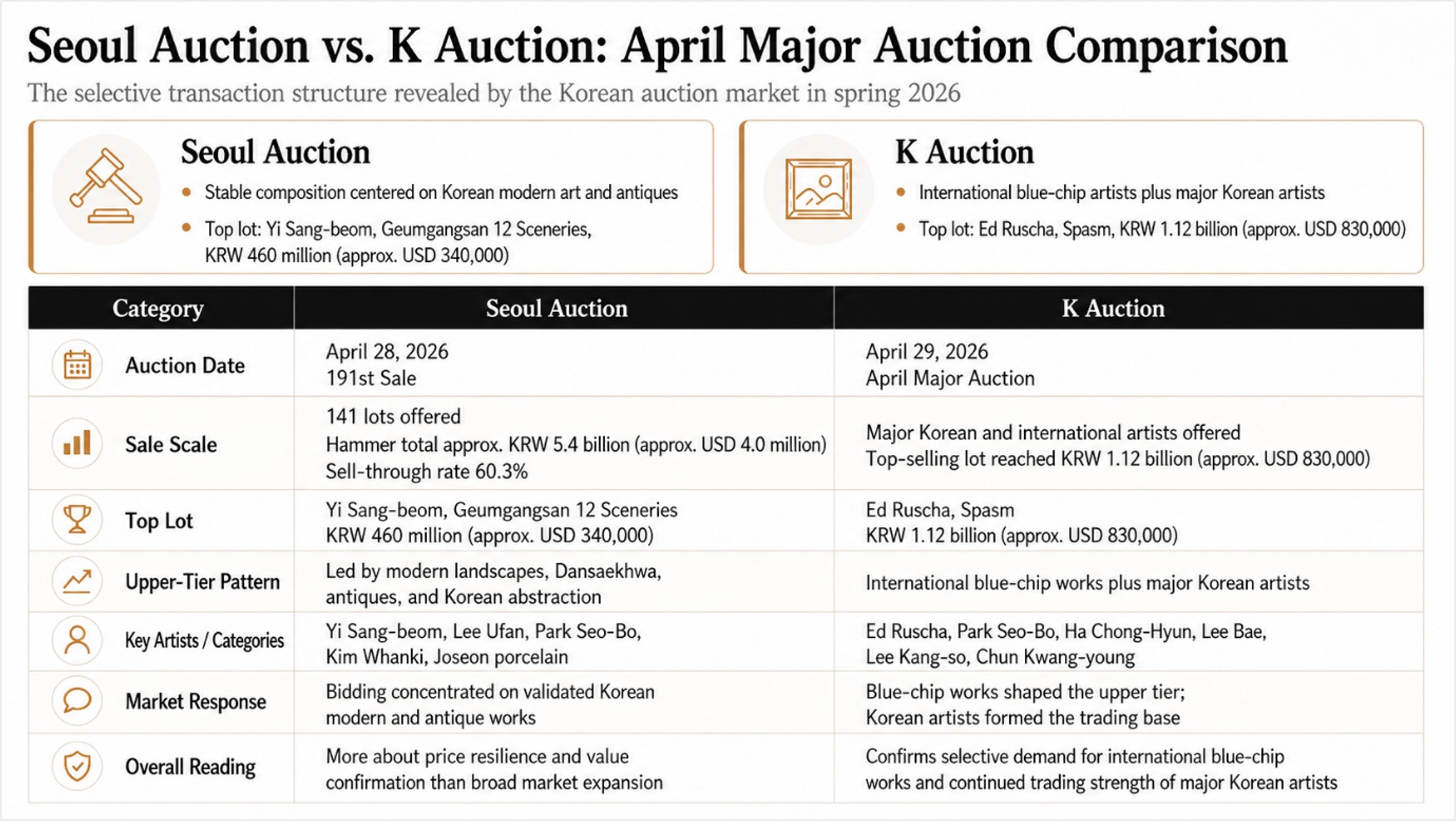
Comparison of the Key Results of Seoul Auction and K Auction’s April Auctions / Chart: K-ARTNOW
These results
suggest not that the Korean auction market has entered a broad recovery phase,
but rather that it is operating within a selective transaction structure.
Collectors did not rely solely on an artist’s name recognition; instead, they
evaluated factors such as the period of production, the specific series, market
history, the appropriateness of the estimate, and future liquidity.
In this context,
auctions functioned less as a mechanism for generating widespread new demand
and more as a venue for verifying whether previously established value could
translate into actual transactions.
Seoul
Auction: A Sale Led by Modern Landscape Painting, Dansaekhwa, and Korean
Antiques
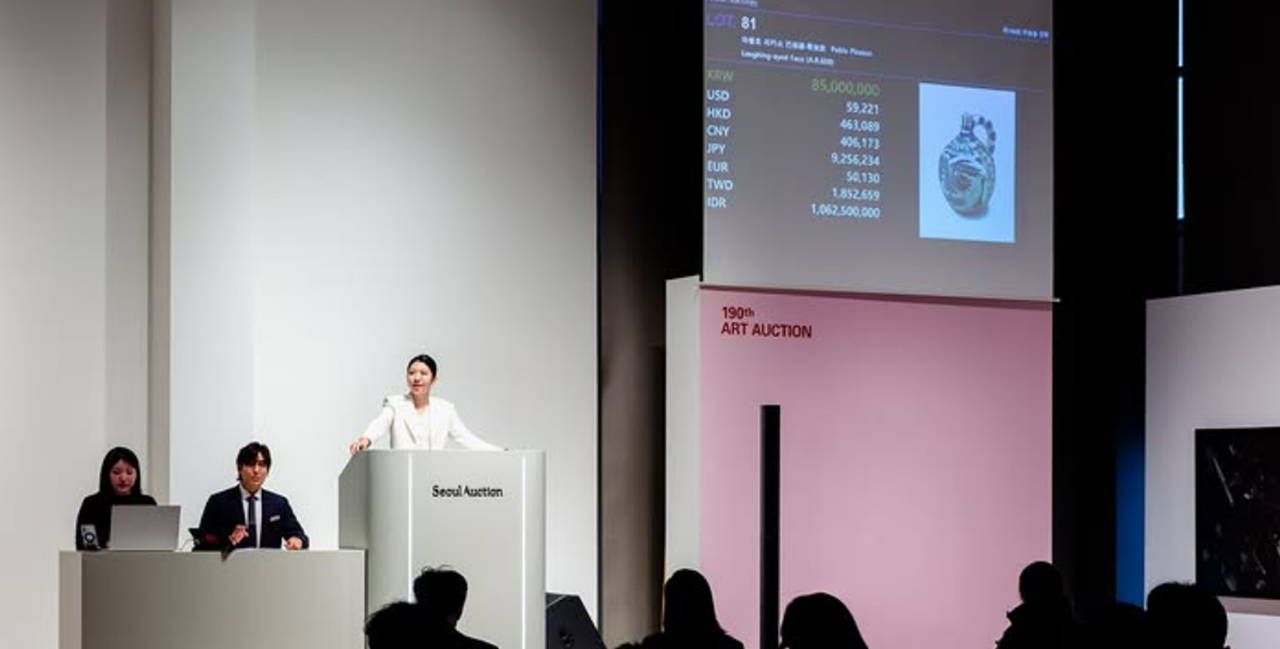
Seoul Auction’s
April sale closed with 141 lots offered, a total hammer price of approximately
KRW 5.4 billion (approx. USD 4.0 million), and a sell-through rate of 60.3%.
The total is based on hammer prices excluding buyer’s premiums.
While this
indicates that a certain level of trading took place, it also shows that the
market did not respond evenly across all lots. In effect, this was an auction
in which buyers selected works carefully rather than bidding broadly.
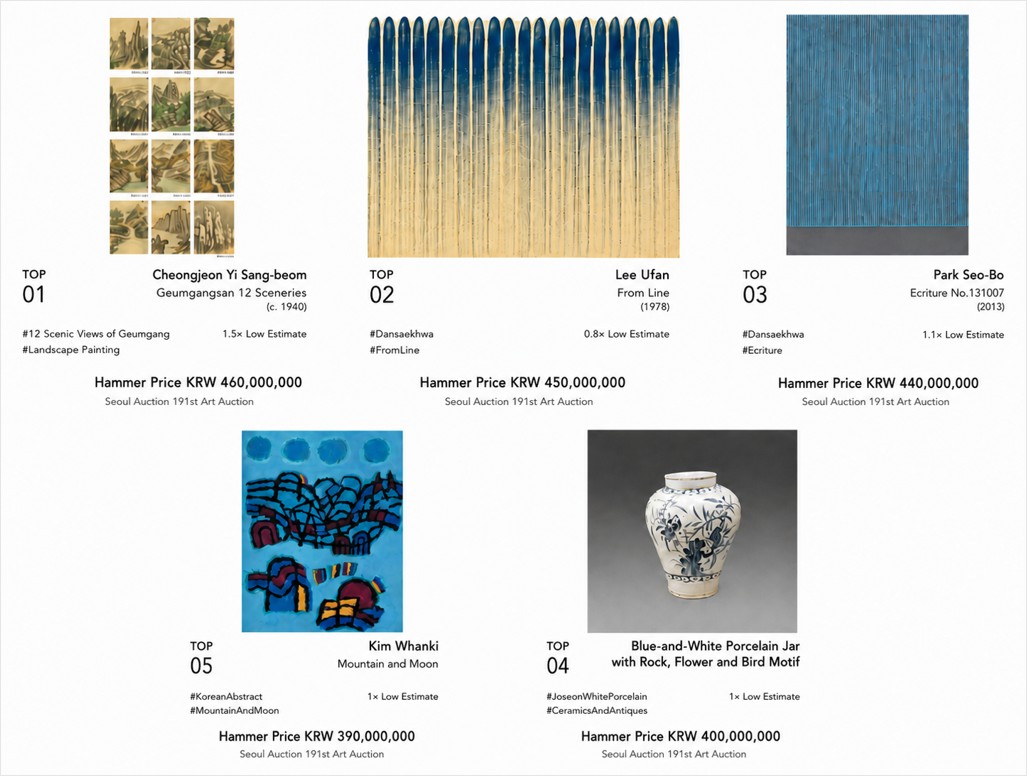
Top 5 Highest-Priced Works / Photo: Seoul Auction Blue Instagram
One notable
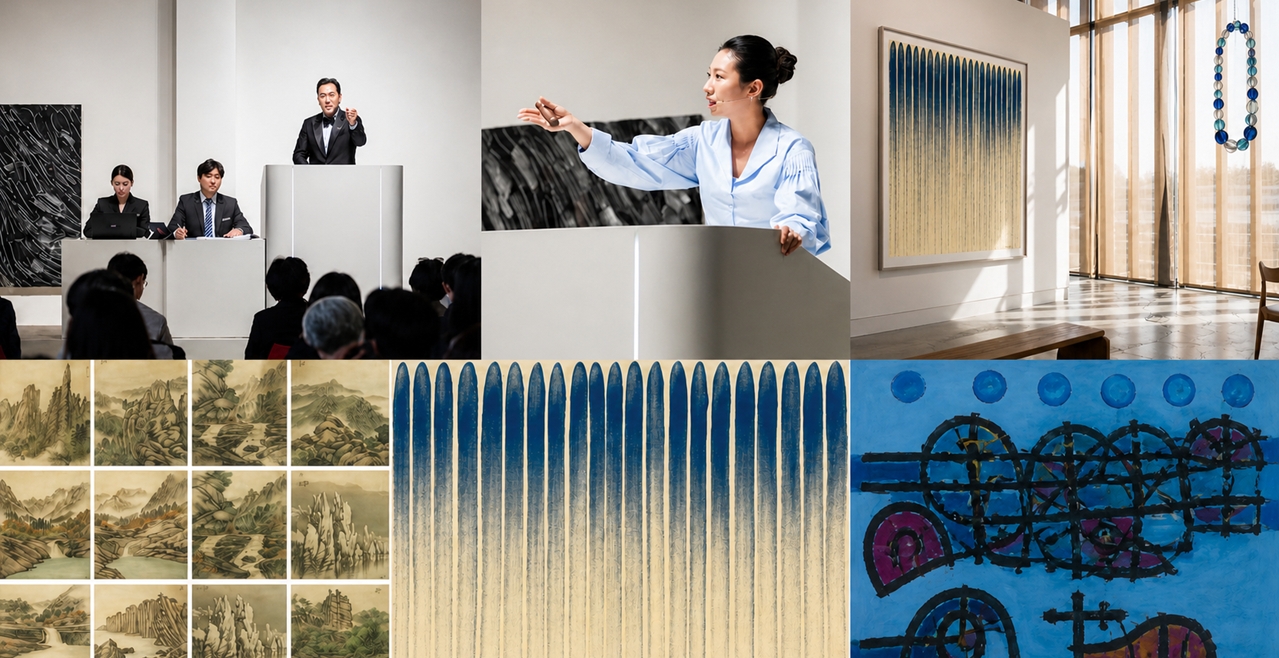
feature of this sale was that the top lots were concentrated within a
relatively narrow price band. The highest-priced work was Cheongjeon Yi
Sang-beom’s Geumgangsan 12 Sceneries, which sold for
KRW 460 million (approx. USD 340,000). It was followed by Lee Ufan’s 1978 From
Line at KRW 450 million (approx. USD 335,000), and Park Seo-Bo’s
2013 Ecriture No.131007 at KRW 440 million (approx.
USD 325,000).
The clustering of
the top three lots within this range suggests that high-end bidding was focused
on a limited group of already validated works.
Yi Sang-beom’s Geumgangsan
12 Sceneries achieved approximately 1.5 times its low estimate.
As a highly symbolic subject in modern Korean landscape painting, Geumgangsan
holds strong historical and cultural significance, and Yi Sang-beom’s work
benefits from a long-established collector base. This result demonstrates that
modern ink painting and traditional landscape painting continue to maintain
price support even within the contemporary auction market.
The works of Lee
Ufan and Park Seo-Bo illustrate the current position of the Dansaekhwa market.
Lee Ufan’s From Line belongs to his iconic line
painting series, while Park Seo-Bo’s Ecriture
represents one of the core bodies of work in Korean Dansaekhwa. The fact that
both works achieved prices in the mid-KRW 400 million range indicates that,
even without a strong upward surge, key works by major artists retain solid
price resilience.
In the antiques
category, the Blue-and-White Porcelain Jar with Rock, Flower and
Bird Motif sold for KRW 400 million (approx. USD 295,000),
ranking among the top lots. This result confirms that Korean antiques, such as
Joseon white porcelain, can still attract high-level bidding when supported by
rarity, condition, and historical value. Kim Whanki’s Mountain and
Moon sold for KRW 390 million (approx. USD 290,000),
demonstrating continued market credibility for the artist.
Overall, the top
results at Seoul Auction were distributed across modern landscape painting,
Dansaekhwa, Joseon porcelain, and Korean abstraction. This indicates that
high-value bidding was not concentrated in a single category, but rather
distributed across several historically established sectors. However, these
sectors remain within areas already validated by both the market and
institutions, suggesting that the sale functioned more as a confirmation of
existing value than as an expansion into new artist groups.
K
Auction: An International Blue-Chip Top Lot and the Trading Base of Major
Korean Artists
K Auction’s April
Major Auction was held at 4 p.m. on April 29 at its headquarters in Sinsa-dong,
Seoul. The sale included works by major Korean and international artists such
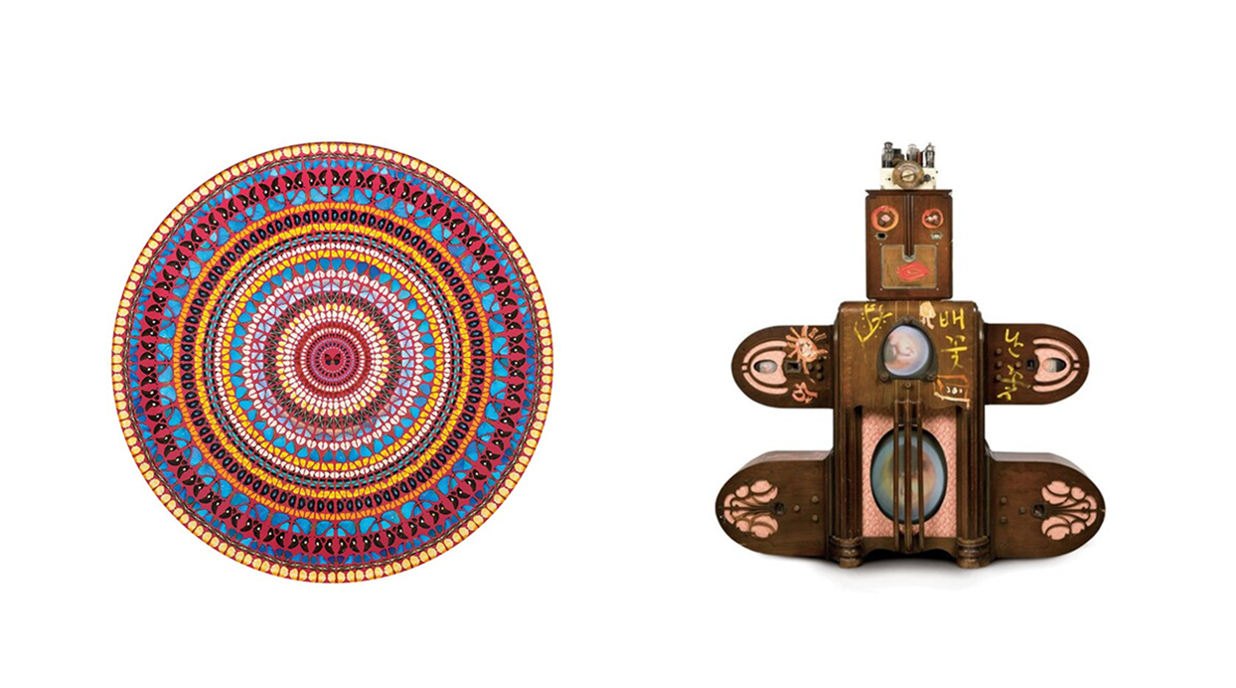
as Ed Ruscha, Damien Hirst, Nam June Paik, Park Seo-Bo, Lee Ufan, Ha
Chong-Hyun, Yun Hyong-keun, Chung Sang-Hwa, and Kim Yun Shin.
While Seoul
Auction presented a relatively stable composition centered on Korean modern and
antique works, K Auction offered a configuration that combined international
blue-chip artists with major Korean names.
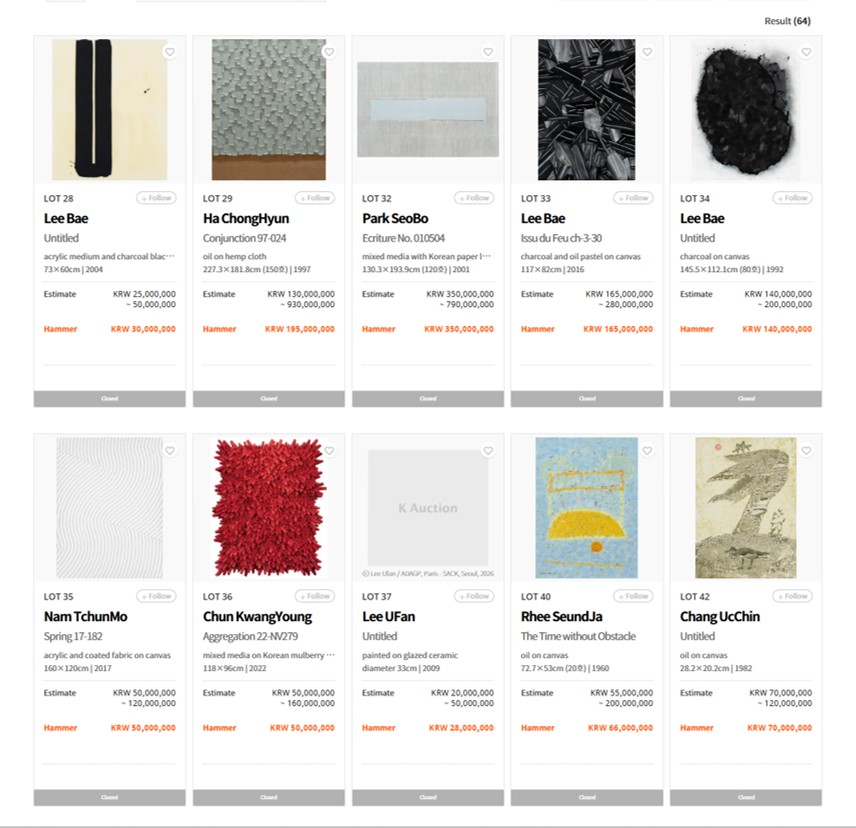
April Sales Results at Seoul Auction / Photo: Screenshot from K Auction Instagram
The
highest-priced lot of the sale was Ed Ruscha’s Spasm.
The 1987 acrylic-on-canvas painting, estimated at KRW 900 million to KRW 2
billion (approx. USD 670,000–1.5 million), sold for KRW 1.12 billion (approx.
USD 830,000).
Although the
hammer price was close to the lower estimate, the result is significant in that
a major work by an internationally recognized blue-chip artist was successfully
traded in a Korean auction. It indicates that selective demand for
internationally validated artists exists within the domestic market.
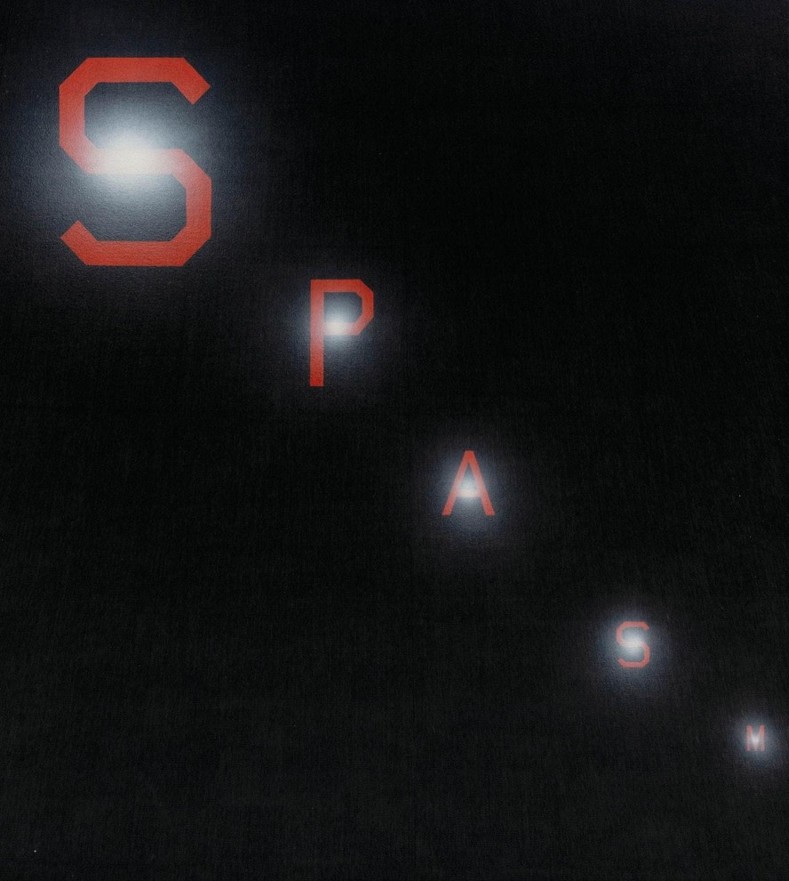
Ed Ruscha (b. 1937), American, Spasm, acrylic on canvas, 152.5 × 137.2 cm, 1987. Estimated at KRW 900 million–2 billion, sold for KRW 1.12 billion. / Photo: K Auction
However, it would
be difficult to interpret the sale of Spasm as
evidence of strong demand for international artists as a whole. The current
Korean auction market does not respond uniformly simply because a work is by a
foreign artist.
Transaction
likelihood increases only when factors such as the artist’s global stature, the
work’s representativeness, the production period, and pricing conditions align.
Among Korean
artists, Dansaekhwa and Korean abstraction formed the core of trading activity.
Park Seo-Bo’s Ecriture No.010504 sold for KRW 350
million (approx. USD 260,000), while Ha Chong-Hyun’s Conjunction
97-024 sold for KRW 195 million (approx. USD 145,000).
Works by Lee Bae
were sold across multiple price points—KRW 165 million (approx. USD 122,000),
KRW 140 million (approx. USD 104,000), KRW 100 million (approx. USD 74,000),
and KRW 30 million (approx. USD 22,000)—indicating that demand for his work is
distributed across various scales and price levels.
Other notable
results included Lee Kang-so’s Emptiness-14021 at KRW
96 million (approx. USD 71,000), Shim Moon-seup’s The Presentation
at KRW 85 million (approx. USD 63,000), and Chun Kwang-young’s Aggregation
99-0187 at KRW 66 million (approx. USD 49,000). In the modern
category, works by Kim Ki-chang and Park Rae-hyun also sold.
These results
show that the center of trading at K Auction, as well, remained anchored in
artists with established market histories and collector bases.
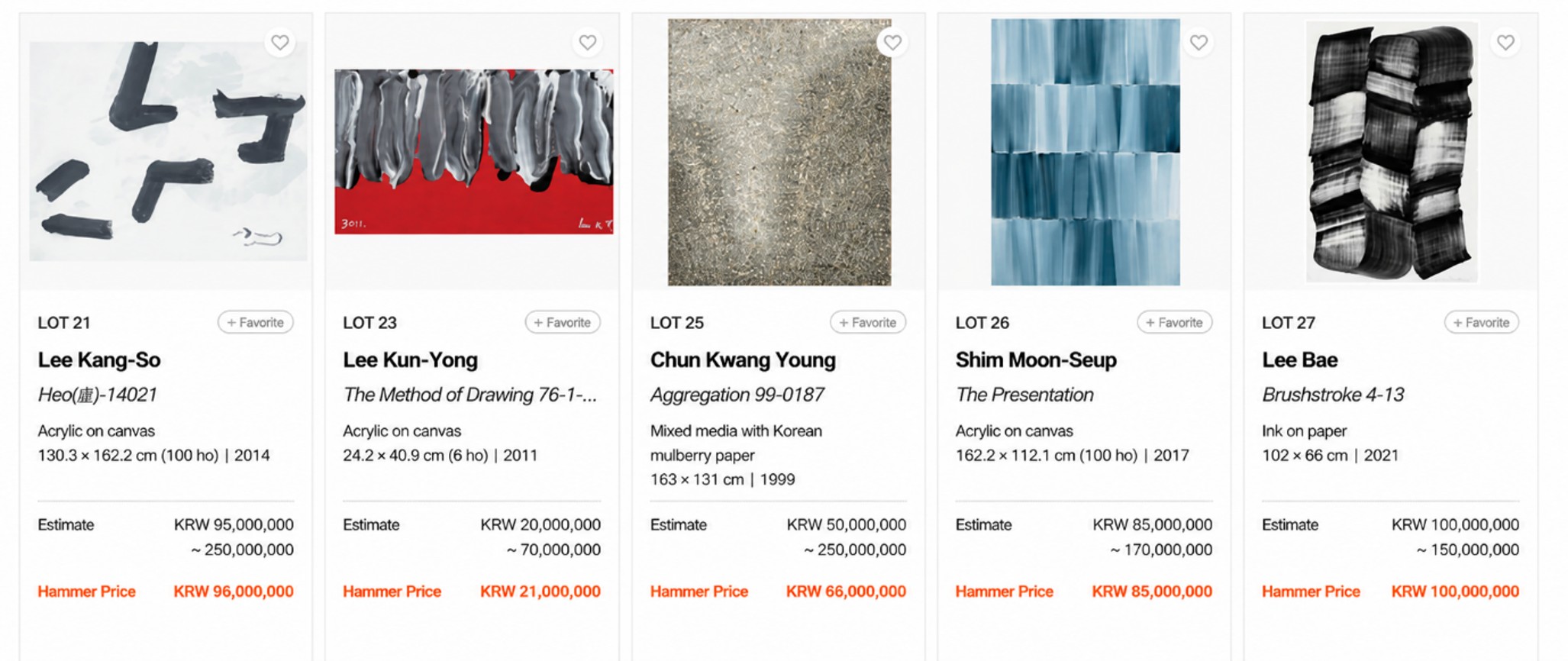
April Sales Results at K Auction / Photo: Screenshot from K Auction Instagram
A defining
feature of K Auction’s April sale was that its top lot was an international
blue-chip work, while the broader base of transactions was formed by major
Korean artists. International blue-chip works shaped the upper price range, but
Korean modern and contemporary artists—particularly those in Dansaekhwa and
abstraction—formed the practical foundation of the auction.
A
Combined Analysis: Auctions Centered on Price Verification Rather Than Market
Expansion
Taken together,
the April auctions at Seoul Auction and K Auction indicate that the Korean
auction market in spring 2026 can be characterized as selectively stable. The
market is neither fully depressed nor in a clear upward cycle. Bidding activity
was present, but it did not extend evenly across all lots. Transactions were
concentrated where validated artists, representative series, and realistic
estimates converged.
Seoul Auction
demonstrated an upper-tiered auction structure centered on modern landscape
painting, Dansaekhwa, Korean antiques, and Korean abstraction. K Auction
confirmed selective demand for international blue-chip works through Ed
Ruscha's Spasm, while simultaneously showcasing the trading
foundation of major domestic artists such as Park Seo-bo, Ha Chong-hyun, Lee
Bae, Lee Kang-so, Chun Kwang-young, and Shim Moon-seup. Although the
compositions of the two auctions differed, they shared a commonality in that
the actual market response was concentrated on established artists and works.
This pattern
highlights both the stability and the limitations of the Korean art market.
Stability is evident in the continued maintenance of transactions around a core
group of major artists. Korean modern art, Dansaekhwa, antiques, Korean
abstraction, and certain international blue-chip works still retain effective
price support at auction.
At the same time,
the limitation lies in the fact that the center of the auction market remains
concentrated on artists whose evaluation has already been accumulated. It
appears that more time is needed for young contemporary artists or experimental
works to secure broad price-forming power in the auction market.
Ultimately, the
April 2026 major auctions should be understood less as evidence of a strong
market recovery than as part of a process in which the auction market is
reassessing its benchmarks following a downturn.
The key trend can
be summarized as the confirmation of selective transactions and the resilience
of prices among already validated works.